Wednesday, October 6, 2010

Week 45: Barns


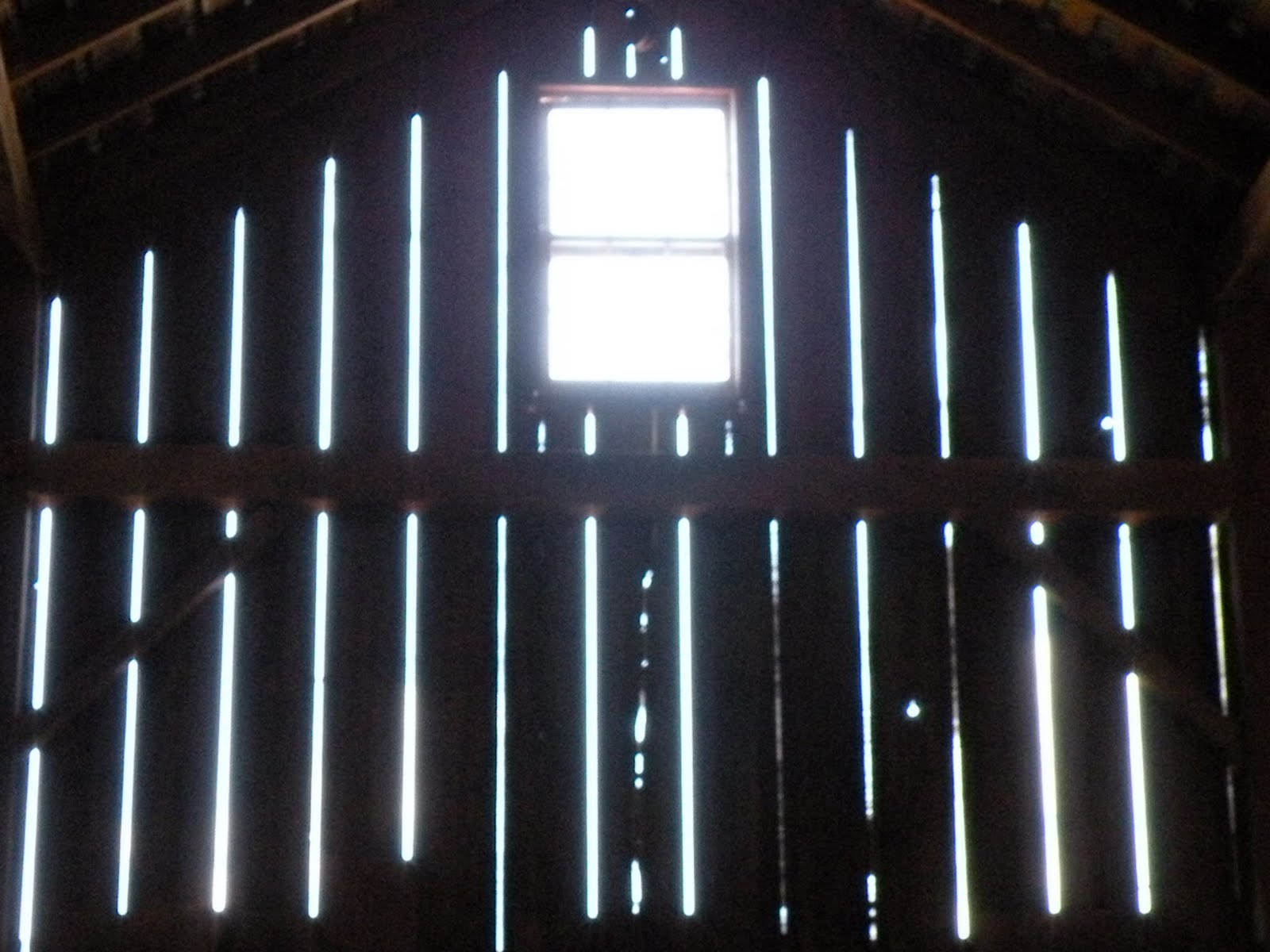
I am percolating a project. I want to hear the stories of local barns. Barns as icons. Barns as embodying the changing culture and legacy of farms and farming.

As an urban pastor in rural ministry, part of my draw to barns is that I know nearly nothing about them, really. Yet, somehow, I love them.

But, true confessions: everything I know about barns I learned in kindergarten.

Old McDonald had a farm – and it was a barn, the farm was.

In the barn were cows and calves, pigs and piglets, horses and colts, hens and roosters and chicks, sheep and lambs, etc., I suppose each in their adjacent stalls. And why? I don’t know, just because animals are nice and warm and fun and make great noises? (The connection between animals in a barn and raising food was never made.)

And Jesus was born in a barn.

And in that dark barn far away there also was a cow, a sheep, a dove, an ox, and a lamb, all co-existing and making soothing noises for a baby to sleep by.

Growing up I never knew a farmer or went in a barn. There was an old structure behind our “old house” (when I was a small child), that I called a barn. And I imagined having my own horse in it. But I have no memory of ever going in this structure. It stood old and empty and longing.

My cousins old, old house in Germantown (Philadelphia) had been the barn where, they said, George Washington's horse slept. But I never, never, pictured it in any way as a barn. That was just a quaint thing to say, I guess.

In college I had a chance to connect with a barn. The first farmer I knew was a Mennonite farmer’s son I met when I was twenty. After his father’s death their Lancaster, PA farm was being auctioned off after seven generations of family farming. He grieved in a way I could not feel. I never saw the barn.

And now? I now have friends who have all kinds of barns.
 A centennial barn that stands empty but for storing the yacht of a friend.
 Huge pole barns that house huge equipment for seed corn farming.
 A small pole barn on an organic market farm that houses a few sheep and cattle.
 Two barns that have been re-constructed as homes, and another as a retreat center.
 One small white barn that was sold recently to a young Amish family.
 One old, dark barn that hosted a dance once, but I had too much fun dancing and never really looked around.

I have not explored barns. I don’t know what they are used for – really. I don’t know the kinds. Or how they are built. I don’t know what it takes to keep an old barn alive.

I don’t know why I love barns. Why my heart goes out to barns. Why they comfort me, even the old falling down ones, as they stand on the corn field across my long driving view. Why they draw my eye.

I ponder such American icons -- wondering if barns are sanctuaries of the land, like country churches are sanctuaries for the people.
I wonder if we know, deep down in our collective earthling consciousness that such shelter is necessary, such honoring essential, for our survival on the land and with the animals. I wonder if barns stand in the gap between the wild, wild world and our domesticated allusion of everlasting abundance, the cultivation of crops, of our daily bread.

Barns seem to me shelters of the presence of God on field horizons, keeping us safe in storms and fed in the cold, holding a warm place between heaven and earth.

And it appears that barns are dying.

Sunday, September 26, 2010

Week 44: Migration and Immigration


Migration and Immigration. How can one thrill the heart and the other weigh down the soul?

My eye is drawn daily to light and wings. At dawn a small flock of sandhill cranes pecks about a harvested corn field, backlit by rays of heaven, streaming and raising steam. At dusk dark shadows of flocks line up the length of power lines, facing the setting sun. Is this their form of prayer? These changes in time and season, in flying from one home to the next and back again, evoke wonder.

Changes of immigration law evoke dread. My friend, Gwen, described walking through the desert where many immigrants cross from Mexico to Arizona.

"There is nothing simple about immigration as it stands in these days. From a legal point of view there are no easy answers at all. But I am responsible for God's point of view. And there is only one answer in scripture for the stranger and the neighbor. That answer is welcome and respect."


If laws pass that make it a crime to aid immigrants without legal documentation, then our whole congregation could be sent to jail. Maybe that would be a good thing. Thirty eight states are considering such lawas. But hopefully another way through the wilderness will be found.

This coming week includes Worldwide Communion Sunday. If only the communion could be honest and equal between the communions of Mexico and the United States, between Nicaragua and Costa Rica, between Uganda and DR Congo, that would indeed be a miracle. Until then, the Mexicans and Costa Ricans, and Africans and African Americans and Native Americans (and German, Irish, English, Finnish, French and Swiss Americans) in our little communion seeks to grow in joy and justice.

The birds may lift my heart. But it is brothers and sisters I need to lift my soul. The flock of One God of All.

Week 43: Rural Prisons and Hope


One measure of vibrancy is "passion for life." This fall our congregation is looking for signs of this passion within and around us.

Mark offered to share his passion with us. He is a member of a Florence family. And he is in prison.

But his imagination is not.

Through words, collages, drawings, and selected music, he gave us a whole new picture of what hope looks like for him, from behind bars.

Here are his words:

Passionate Light

To me passion is priceless. Paid for by living life. I was in prison -- so I never paid to go see passion of the Christ. True passion is always right. Fueled with white light. Which we can only visualize -- through holding our hopes tight.

My passion probably came to me through infinite veins. Long before my soul took hold. Long before I became a name. While in the womb hearing the rain. Internal patterns linked like chains.

Our passion often gets cut down to limited lover’s tales. The excuse for such things as Jarreds, De Beers, and Zales. True passion can fill sails. And free mental ships from docks. Trust me -- it’s been my passion, for life -- while I’ve been locked, that keeps me creating my happiness -- with the limited tools I’ve got.

True passion never announces itself. Instead you find it there. In the part of your true being -- that is as delicate as air. .

My passion


In the last five years I have learned that prison is very much part of the reality of rural life in the counties around Florence Church. So much humanity, locked up and hidden away. I have much to learn about the power of imagination that sustains and stretches hearts and minds behind bars, but toward a future of vibrant possibilities.

Week 42: Villa-Miller Farm Meeting


More than sisty farmers gathered at Villa Miller, the seed corn and soy bean farm of Martha and Henry Miller. They were there to hear about land conservancy for farm acreage. I saw a small handful that looked under fifty. What will happen to all the acres in soy beans and corn in the next twenty years. Henry fielded many questions about strip farming -- including other crops in alternate rows and allowing him to drill in his seed without disking the field.

The sense of vibrancy was well grounded. While options for certification of ecologial farm compliace was explained by the young extension service worker, the room was quiet.

Most of the evening was a new foreign language for me. I learned more, as usual, through pictures. I never knew that different parts of the root systems of the corn plant grew at different temperatures.

(Maybe this is why my vegetables never grow well in the pots on my back deck. Hmmmm...the earth gets warm quite quickly.)

As the setting sun glinted off Henry's massive machinery, farmers scattered, and then talked in twos and threes among the trucks and tractors. I would have loved to eavesdrop.

What does the farm world look like to these professional farmers who manaage worlds of mathematics and machinery to produce more per acre than has ever been produced before. What is the future of this kind of wisdom and skill in soil care?

When I asked a pastor/farmer what he thought the future of these farms would be he said,
"Oh, the big companies will buy all these corn and soy bean operations up and run them."


What might that look like? Who will tend Henry's well cultivated land?

Monday, September 6, 2010

WEEK 41: Water, Bread, & Wine (with room for ice cream for dessert)


Our Well Endowed Aunt Lilly provided for us – all fifty of us – a weekend of vibrancy.

Amigo Centre, our friend, was our host:
What is this place where we are meeting,
only a house, the earth its floor.
Walls and a roof sheltering people,
windows for light, an open door.
Yet it becomes a body that lives
when we are gathered here
and know our God is near.*

We had our own rooms, private baths, abundant food and hot coffee, blue lake, crisp air and clear sky. There were long trails through the marsh lined with marsh marigold and fringed gentian and visited by deer. We ventured in canoes and sailboats on the water, on nature walks and treasure hunts in the morning, conversing in the “passion booth” at noon, and reveling in popcorn, Karaoke, dancing and games in the night.

Time comes to a fullness.

When Suzanne led us in worship on Sunday morning it was to gaze out on the forest and the lake beyond as we sang “What is this place.” We breathed new air. We became a new body.

A body of Vibrant Life, given by amazing grace, we walked down to the lakeside for a baptism. We sang and danced the old Shaker tune, “’Tis a gift to be simple,” bowing to one another and to God in our circle of friendship and faith. Water gathered from the lake poured new life over Nora. And, “baptized into ordination for ministry” as the Church of the Brethren understands this rite, Nora served us the bread and wine of the living Christ.

Here we accept bread at his table,
broken and blessed, a living sign.
Here in this world, dying and living,
we are each other’s bread and wine.
This is the place where we can receive
what we need to increase
God’s justice and God’s peace.*

*“Here in this place” by Huub Oosterhuis
Dayenu! This would have been enough! But David suggested that we end our time with dessert at Ice Cream Heaven, the famous Nottawa Sand Lake Party Store – on Aunt Lilly. So we filled the place with a long line, more conversation, and piles of ice cream that dwarfed the cones.

David says, “Food is God’s love made physical.” What a sign of abundant love, that after two nights and most of three days together, huge brunch and dinner meals, lots of laughing, walking and playing together, we still had room for dessert!

Yes, the Commonwealth of God is like a Great Banquet,with room for dessert…AMEN!

Monday, August 30, 2010

Week 40: Vibrant -- "Lit up from within"


The text this Sunday was the Burning Bush (Exodus 3). On my drive to church I was struck at dawn by glory rays streaming through the clouds and trees over Constantine. I wondered, ”Did Moses catch this power surge as sun ran riot through a desert shrub? Would it be a less glorious appearance of God?”

“And, what is it that lit up Moses face, striking awe among desert congregation?”

“This ‘vibrant’ I am seeking in church and community. What is it, really?”

In Leaving Church, Barbara Brown Taylor describes the Presence of God as being lit up from within.

As hard as I have tried to remember the exact moment when I fell in love with God, I cannot do it. My earliest memories are bathed in a kind of golden light that seemed to embrace me as surely as my mother’s arms. The Divine Presence was strongest outdoors, and most palpable when I was alone. When I think of my first cathedral, I am back in a field behind my parent’s house in Kansas, with every stalk of prairie grass lit up from within. …Because I was not brought up in church, I had no religious language for what happened in that gold-lit field…Day by day, the practical implication of this feeling of communion was that I could not walk by a hurt thing without hurting too.
(Barbara Brown Taylor, Leaving Church (pp. 22, 23, 25)

She sees the light as well when it emanates from God’s human creatures. She describes her husband after a Sun Dance ceremony:

His face leaked light, as if every ray of sun that had landed on him that week had seeded his pores. Ed shone, and when he looked at me I felt the beam hit me in the chest across fifty feet of wet pasture.
(191)


These experiences left Barbara often in the dark at church in her role as priest. And it is a story I also heard, and felt for myself, in my own brief Exodus from church in Costa Rica. I only met one person there, Armando, my Spanish Intensive teacher, who was lit up by church. On the other hand, I saw light streaming from folks who had left the church behind, or on the side of their main stay of tending land, building community, and growing and eating good food.

How is God sparking up?

It seems in the USA we go to extremes to find the “lightning bolt” that has fallen into memory.

This week 40,000 people will go into the extreme environment of the desert of Nevada for Burning Man, to create a city of creativity and community, self expression and self reliance, no holds barred and no harm done, into be “lit up from within.”

This Sunday at Florence Church of the Brethren Mennonite we entered the old God story in the old way. Thirty five of us came to hear and imagine Moses’ conversation with the “I AM” from the burning bush. We took off our shoes in the presence of God, and we stooped low to wash one another’s feet. Then we were “lit up from within” as we recalled our own holy moments.

Martha recalled arriving in Cuba for a women’s conference, walking through the mud, and being met in the middle of the night by the women of the church who washed their feet. Tears flowed.

Fridbert remembered climbing as high as he could in trees when he was a boy, to be alone, to sway in the wind, to watch all the littleness below. “Sometimes we don’t know until later that we are having a God moment. When I was in those trees I did not know. Now I see.”

Jane and Nora and Dallie and Mary said living bare foot was their way of life. And I remembered that it was my mother’s way as well.

Don reminded us that our feet ground us in holy earth, as much or more than holy heaven.

So, I am not leaving church. I am longing for sparks, both within and out. It is conversations with God and the God World that light me up from within.

Then even a dust mote in the light sparks glory.

Thursday, August 26, 2010

Week 39: Lovely Michiana

Home of the Wenger Family at the Hermitage

A day of prayer at the Hermitage (Dutch Settlement Road, Three Rivers) was settling to my soul. The beauty of this place -- roll of hills, waves of grass, silence, but for the wind -- is both familiar and new.

Now I have a whole new set of questions to ask of my native geography.

We shall not cease from exploration
And the end of all our exploring
Will be to arrive where we started
And know the place for the first time.

T.S. Eliot -- "Little Gidding"
(The last of Four Quartets)